Monte Rosa: The Day the Plan Broke (and What It Taught Me)
I went into Monte Rosa with a simple plan and a clean timeline. Start at the Punta Indren lift station around 3,260 metres, hike to Rifugio Gnifetti, sleep, then attempt Capanna Regina Margherita the next morning — the highest refuge in the Alps at 4,554 metres.
Reality did what it always does in the mountains: it negotiated.
The plan changes because the weather is "too good"
At the lift station the conditions were excellent. Blue sky from horizon to horizon, no wind, the kind of visibility where you can trace every ridge line across the massif. Clear, inviting, almost disrespectfully perfect. When the mountains look like that, they feel generous — and that's exactly when you stop respecting them. The client looked around, felt the energy, and asked to climb Punta Giordani first.
I resisted. Not because I didn't want the summit, but because I didn't like the setup. We weren't provisioned for an extra peak: not enough water, not enough food. That matters at altitude, where small miscalculations turn into expensive problems.
I still agreed.
We summited Punta Giordani, and I felt the price immediately. Hunger and thirst are not minor discomforts up there. They are the beginning of errors.
Leaving the safe track
After Giordani, the objective was Rifugio Gnifetti — our original destination and where we needed to be before dark. At the top, there were two visible tracks in the snow: one heading toward Piramide Vincent, the higher peak nearby, and one running along the ridge that would take us directly to the refuge.
We were tired and dry, so the ridge route made sense. But as the afternoon wore on, the snow began to soften and the tracks faded. We lost the line. Instead of staying high where the terrain was packed and predictable, we dropped lower into untouched snow.
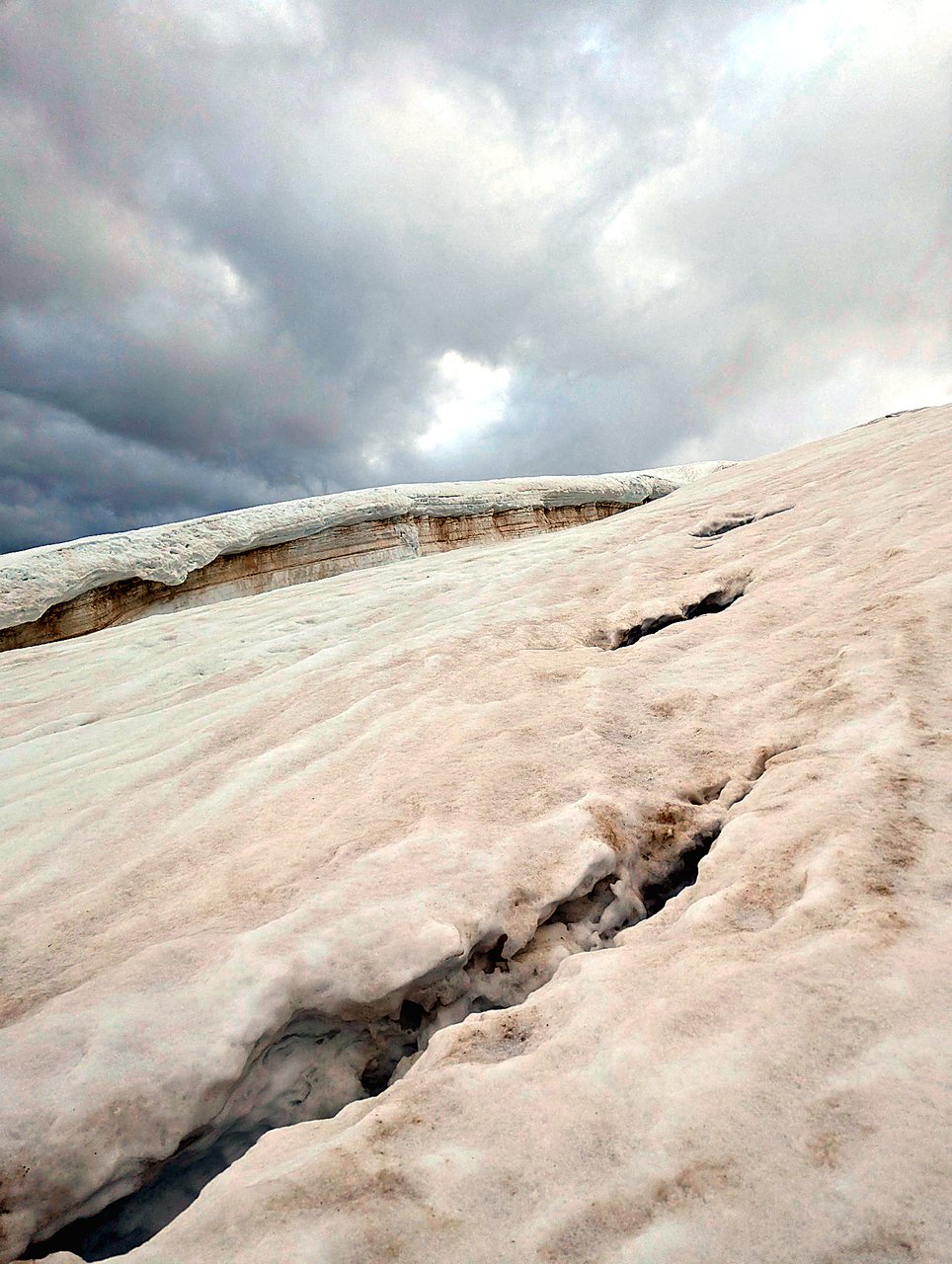
Fresh powder looks harmless. It isn't. It hides rock gaps and cracks that your feet only discover the moment you lose friction.
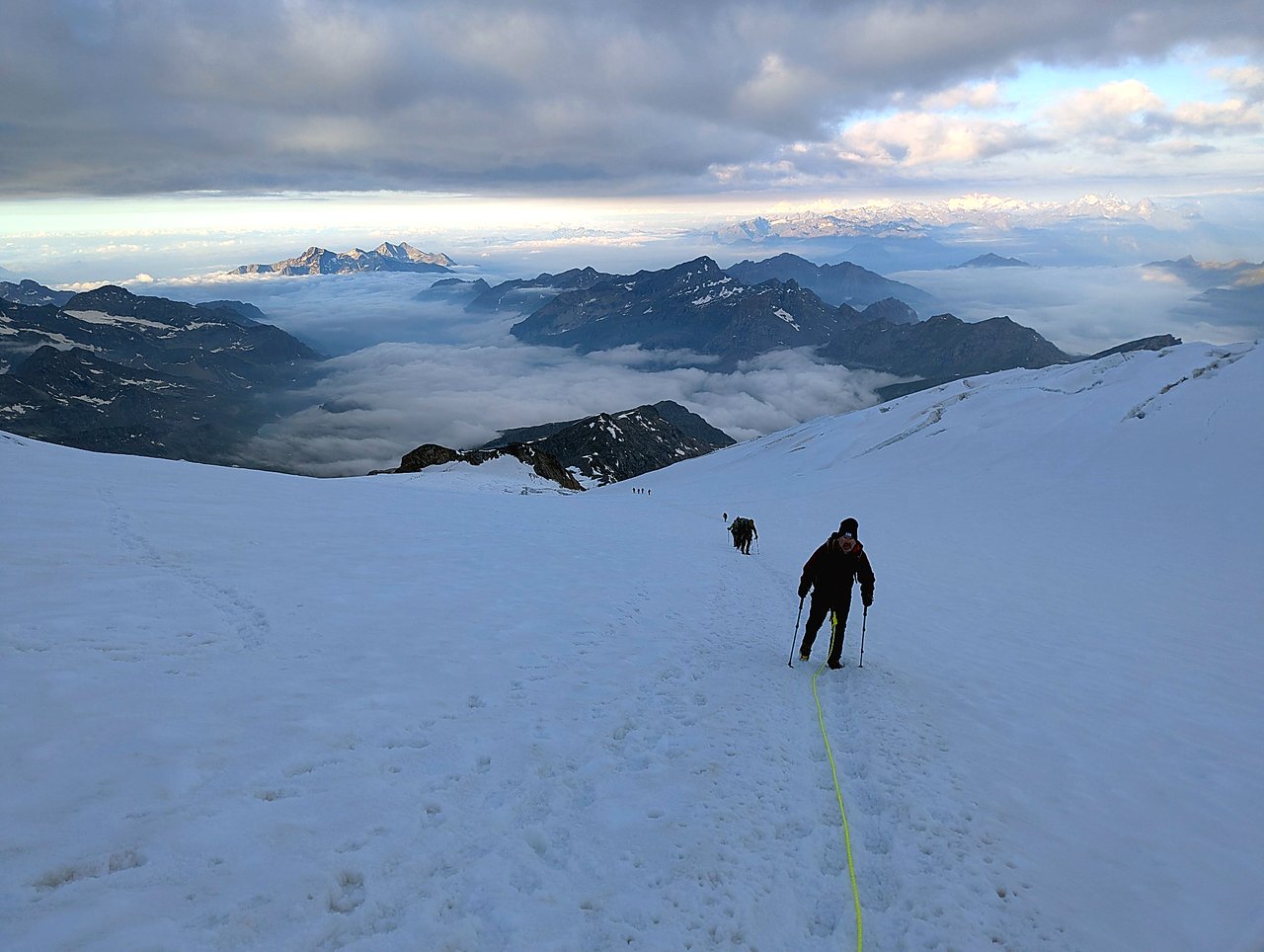
The client slipped and his leg dropped into a small crack hidden under the snow. Not a full fall — just one leg, wedged tight. I had to pull him out, but the damage was done. His leg was hurt, and that moment was when the climb shifted from ambitious to management.
Looking back, the key mistake wasn't the slip itself. It was losing the trail and not slowing down to check the terrain once we did. When the tracks disappeared, that was the signal to stop and reassess — not to keep moving on instinct.
Route discipline
Gnifetti: hunger, thirst, and the quiet warning
We made it back to the ridge, which was mercifully clear of snow, and descended from there. We reached the refuge just in time for dinner — exhausted, hungry, and dry. We ate, rested, reset, and kept the original objective alive for the next morning.
Before dawn, we geared up and started for the glacier. The client gave a small hint that his leg hurt. Not a refusal. Not a clear "I can't." Just enough information to be easy to dismiss.
On the glacier, that hint became reality. The pace collapsed. We were roped together, and I wasn't just guiding anymore — I was physically towing the situation forward.
4,200 metres: the velcro strap that changed everything
At around 4,200 metres, I needed my ice axe and asked the client to open the velcro strap on my backpack.
He couldn't. Not "struggled a bit." Couldn't figure out a velcro strap.
Hard stop signal
That was the clearest signal of the whole trip. Cognitive function slipping. Whether from exhaustion, altitude, pain, or all three, it meant decision-making and coordination were degrading. At that point, pushing forward stops being tough and starts being reckless.
Not long after, he admitted he couldn't continue. We tried a painkiller. We tried another hundred metres. I turned us around.
That was the right call.
The descent: where the danger actually lived
People romanticize the ascent. The descent is where accidents cash in.
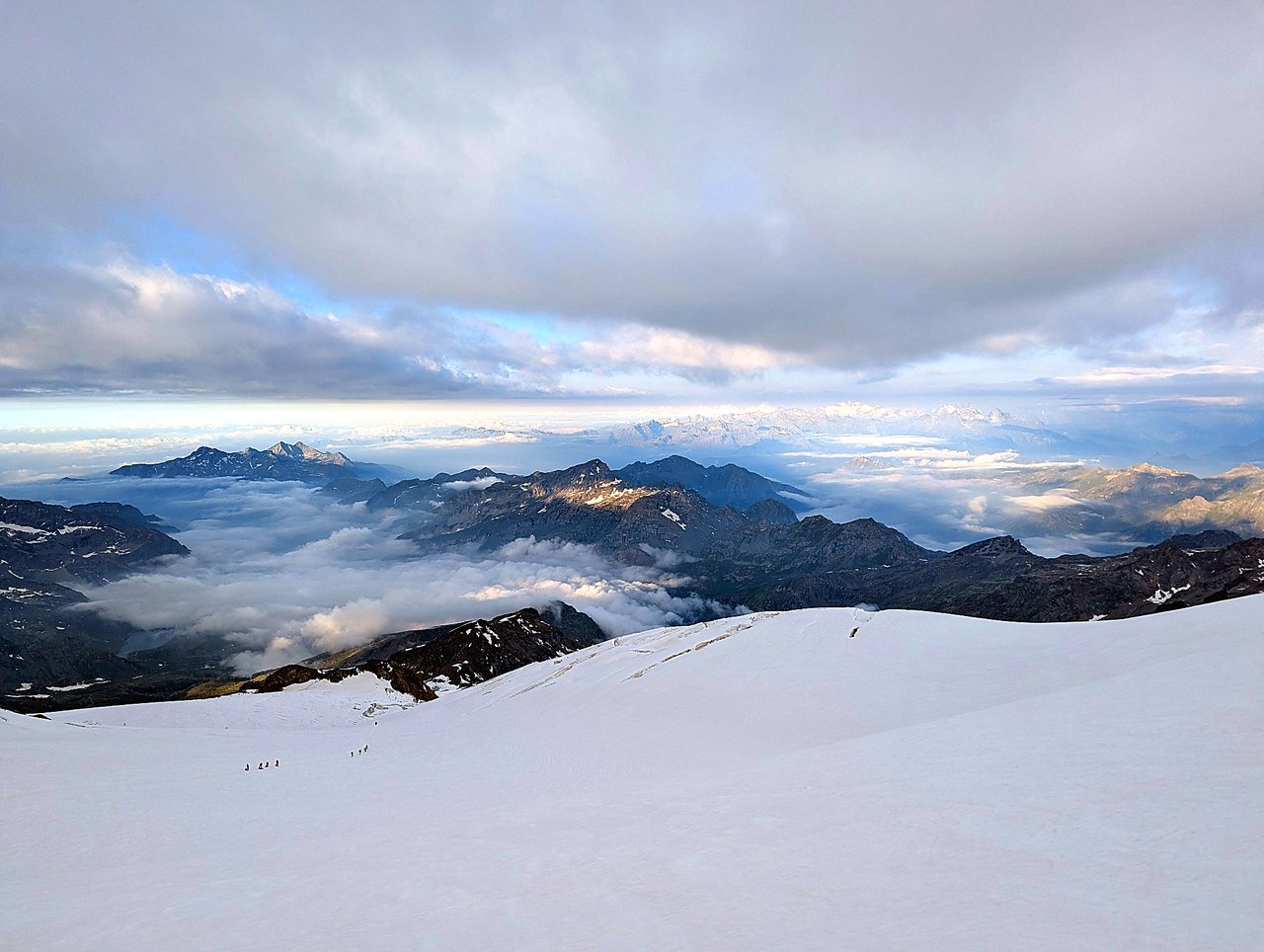
Going down, the client had lost his balance. He slipped repeatedly on snow, and I stayed behind him short-roping to keep him secure.
Near the end, the terrain turned steep and rocky. I made a call I'm not proud of: I unroped. I wasn't confident enough in my short-roping technique on scrambling terrain, and instead of solving that problem with structure — pitches, secure stances, controlled transitions — I removed the rope entirely.
That created the scariest moment of the day. He slipped on the rocks. I jumped to intervene. He stopped himself just in time.
For the rest of the descent, I stayed directly in front of him, acting as a physical block. It worked. But it shouldn't have been the plan.
Lesson learned
What I learned (the useful version, not the motivational one)
This climb didn't fail. It trained me. Expensively.
- Stick to the plan unless you can properly support the new plan. Good weather is not a reason to change objectives. Good weather is how people talk themselves into poor logistics.
- Food and water are safety gear. If you're short on either, you're not traveling light. You're underprepared.
- Hints are data. Treat them like data. Pain hints, fatigue hints, mental fog hints — don't wait for a dramatic announcement. Most clients don't want to feel like the problem, so they drip-feed the truth.
- Cognitive slips are a hard stop signal. The velcro moment was more important than any altitude number. If someone can't perform simple tasks, everything else is compromised.
- Technical decisions get stricter on the way down. Fatigue and gravity are working together against you. That's when discipline matters most, not least.
We made it back to the lift, back to the car, and home. No summit. No hero photo. Just a clear understanding of how quickly a strong day becomes a chain of small compromises.
Summit fever isn't always loud. Sometimes it looks like a perfect sky and an innocent request to add one quick peak.
And sometimes the mountain teaches you with a velcro strap.